西江月·平山堂 My Visit to Pingshan Hall
已更新:4月6日
西江月·平山堂
原作: 苏轼(字子瞻, 号东坡居士; 11世纪北宋)
英译: 闵晓红(2024.02)
三过平山堂下,
半生弹指声中。
十年不见老仙翁,
壁上龙蛇飞动。
欲吊文章太守,
仍歌杨柳春风。
休言万事转头空,
未转头时皆梦。
My Visit to Pingshan Hall
(in memory of my beloved teacher)
-to the tune “The Moon over West River “
Chinese original by Su Shi
English version by Julia Min (Feb. 2024)
This is my third visit to his Pingshan Hall.
In a snap of fingers my life’s already half short.
He’s left us for ten years, gone to heaven.
Yet his cursive on the wall lives as a flying dragon.
In memory of the mayor of those great writings,
We sing his ci ‘weeping willows in spring wind’.
Don’t say all things turn to nothing once one leaves.
I’d say life itself is a dream, even before one leaves.
Notes:
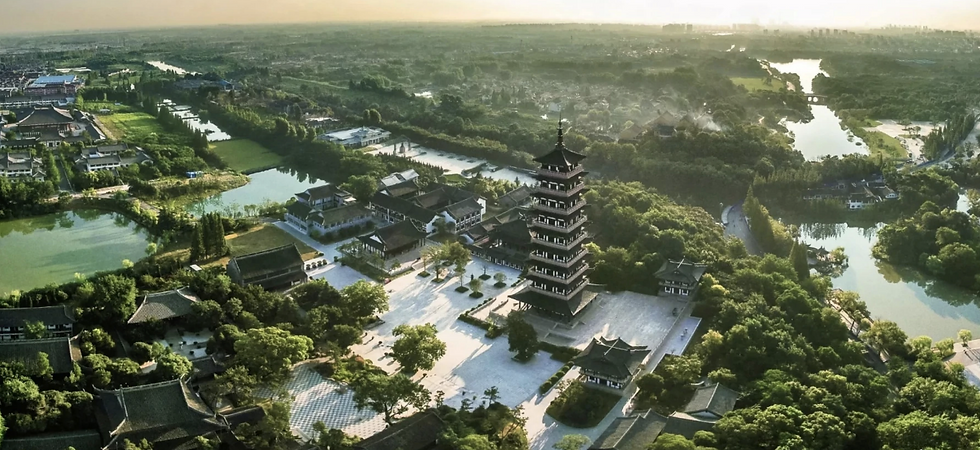
1. Pingshan Hall: the Hall of Mt. Ping (or Pingshan), a complex of halls and pavilions attached to the Daming Temple in Yangzhou. The site enjoys a panoramic view of the Yangtze River and a network of hills and lakes. If you would like to know more about the site, please refer to our translation in this series, “To Zhang Woquan at the Bracing Pavilion of Huangzhou” (Shui diao ge tou · to Zhang Woquan).
2. My beloved teacher: Lord Ouyang (Ouyang Xiu), who had the hall built and gave it its name when he was Mayor of Yangzhou.
3. A flying dragon: the Chinese dragon is a long, serpentine mascot. Cursive calligraphy can be as vivid as a dragon flying across the sky. ("... 手种堂前垂柳,别来几度春风?
文章太守,挥毫万字,一饮千钟。...")
Appreciation:
Written around 1084, this little ci carries the weight of a lifetime. Su Shi, at last released from exile in Huangzhou, makes his way north and stops at Pingshan Hall—a place he loved, and a place haunted by memory. His beloved teacher, Lord Ouyang Xiu, built this hall decades ago. Now Ouyang has been gone for ten years.
The poem opens with quiet wonder: a third visit, half a life already spent. Time moves not like water but like a snap of fingers. The teacher has left for heaven, yet his cursive script still dances on the wall—a flying dragon, fierce and alive. For English readers, Shakespeare says the same: "Nor war's quick fire shall burn / The living record of your memory." Art endures where flesh cannot.
Su Shi then turns to Ouyang's own lyrics, singing "weeping willows in spring wind"—an act of loving homage, a conversation across death. And then comes the Daoist sigh: Don't say all things turn to nothing once one leaves. I'd say life itself is a dream, even before one leaves. Here, the enchanted duke Prospero in The Tempest speaks beside him: "We are such stuff / As dreams are made on, and our little life / Is rounded with a sleep." Neither poet despairs. The dream is not emptiness—it is release.
If all is illusion, then loss is also illusion. What remains is gratitude: for the teacher, for the hall, for the flying dragon that still breathes on the wall. Elegy and enlightenment become one.
Reference:
《朝中措.平山堂》 欧阳修(1007-1072),字永叔,号醉翁 平山栏槛倚晴空,山色有无中。 手种堂前垂柳,别来几度春风? 文章太守,挥毫万字,一饮千钟。 行乐直须年少,尊前看取衰翁。
picture from Google


留言